Why Does Garba Make Strangers Feel Like Friends?
Maybe the magic of Garba isn"t that thousands of people dance together. Maybe it"s that, for a few hours, nobody feels like a stranger


Why Does Garba Make Strangers Feel Like Friends?
Maybe the magic of Garba isn't that thousands of people dance together. Maybe it's that, for a few hours, nobody feels like a stranger
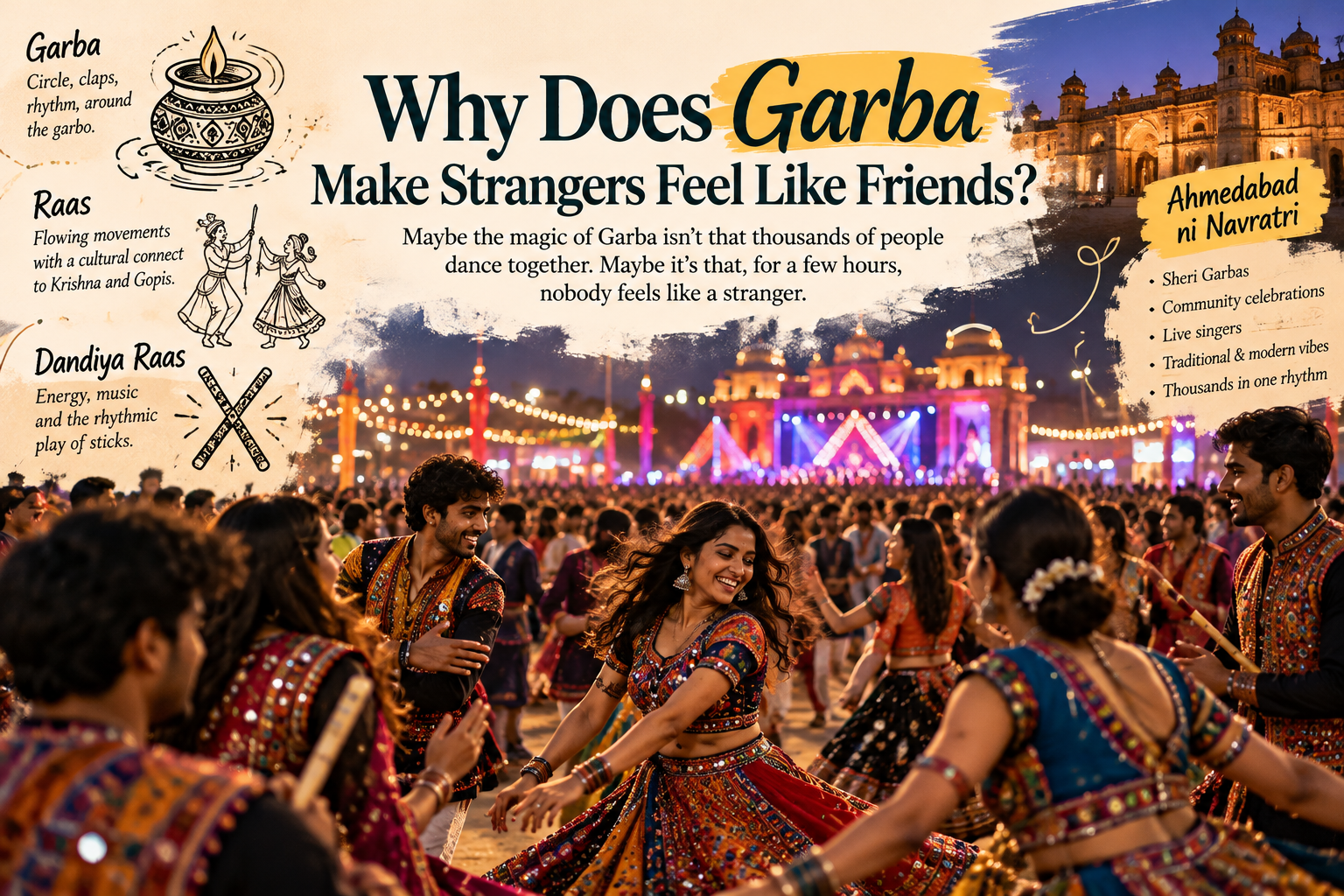
Ahmedabad during Navratri doesn't just look different. It sounds different. As evening settles in, the city starts changing its rhythm. Traditional outfits come out of cupboards, jewellery gets checked one last time, dhol and Garba songs begin filling the air, and somewhere nearby a circle is already forming. You might hear someone asking, “Aaje kya Garba che?”Someone else is fixing their chaniya. Someone is carrying dandiya. Friends are making plans about which ground to go to. And then the music starts. But here's the interesting part.
Garba isn't simply Dandiya.
The two are often used interchangeably today, especially in big urban events, but the traditions have their own character. Traditional Garba is performed in a circle around a central garbo, an earthen pot associated with the lamp and the feminine divine. The dancers move around it,clapping and following a rhythm that gradually builds. Raas has its own history and associations with Krishna and the Gopis, while Dandiya Raas brings the familiar wooden sticks and rhythmic exchanges into the movement. And that circle matters.
Because the circle isn't just a shape. It is the reason Garba feels different. In a traditional Sheri Garba, the celebration could be a neighbourhood affair, people coming together in their own community spaces. Today, Gujarat also has massive organised events where thousands gather to dance, listen to singers and celebrate together. Ahmedabad and Vadodara have become major centres of this Navratri culture.
In fact, UNESCO inscribed Garba of Gujarat on its Representative List of the Intangible Cultural Heritage of Humanity in 2023. UNESCO describes it not merely as a dance, but as a practice passed down through generations, one that can bring people together across social and economic backgrounds. But you don't really understand that description until you stand inside the circle. Imagine arriving at a Garba ground where you don't know anyone. The first few minutes can be awkward. “Main kahan join karu?” Everyone seems to know the steps. The circle is moving. You are trying to figure out whether you're supposed to clap, turn, move forward, or just pretend you know what you're doing. Then someone makes a little space. You join. You miss a step. Someone laughs. You laugh too.
“Bas rhythm pakad.”
And suddenly, something changes. You still don't know their names. But you're dancing with them. Maybe that's the strange magic of Garba.
You don't need an introduction to enter the circle.
You don't need to know someone's profession, college, salary, Instagram followers, or social background. For those few minutes, a college student can dance beside a businessman. A family can share a circle with strangers. Someone who came alone can slowly find themselves surrounded by people. And the person opposite you? Maybe you have never met them before. Yet somehow, after three rounds, you both know exactly when the next step is coming.
Naam nahi pata, pan vibe match thai gayi.
That's a very unusual kind of friendship. Not necessarily the friendship that continues after midnight. Not always the kind where you exchange numbers. Sometimes it's simply the comfort of sharing a moment with another human being. And perhaps that's something we are slowly losing outside the Garba ground. We have never had more ways to connect. Instagram. WhatsApp. Group chats. Followers. DMs. Yet spontaneous connection with strangers can feel strangely difficult.
We sit beside people without speaking. We enter new workplaces and wait for someone else to introduce us. We see someone standing alone and wonder whether talking to them would be awkward. Garba removes that awkwardness for a while. The music gives you an excuse. The circle gives you a place. The rhythm gives you something to share.
Of course, Garba isn't automatically inclusive. Not everyone feels comfortable in a crowded ground. Some people arrive alone and remain at the edge. Some events can be expensive. Some don't know the steps. And sometimes, the biggest circle can still make someone feel like an outsider. Which is why perhaps the real spirit of Garba isn't simply dancing together. It is making space. That tiny movement when someone notices you're standing outside.
That “Aavo, aa side thi.” That stranger who slows down because you've lost the rhythm. That friend who pulls you into the circle. Maybe that's what makes the tradition so powerful. The circle keeps moving, but it keeps making room. And perhaps that's why Garba feels so much bigger than dance. Because for a few hours, people don't have to prove who they are before they can belong. They just have to find the rhythm. The music eventually stops. The lights begin to fade. The dandiya are put away. Everyone goes back to their different lives. But maybe we can carry one thing beyond Navratri. The habit of making space. For the new person. For the quiet person. For the stranger standing at the edge. Because maybe the magic of Garba isn't that thousands of people dance together. Maybe it's that, for a few hours, nobody feels like a stranger. And when there is no dhol, no dandiya, no Garba circle around us are we still making space for strangers?
-- Pranay S. Pale