“UN’s Selective ‘Concern’ Has a Favourite Country - India”
“UN’s Selective ‘Concern’ Has a Favourite Country - India”


“UN’s Selective ‘Concern’ Has a Favourite Country - India”
Yo, so last night I was deep in that classic CS student scroll (compiler still throwing errors, brain half-asleep) and stumbled on a X post. It kinda stuck with me. It pointing out how the UN Human Rights office dropped a statement about detentions and the right to peaceful assembly during protests in Delhi… but then stays pretty quiet on a whole bunch of other situations. The contrast just feels off.
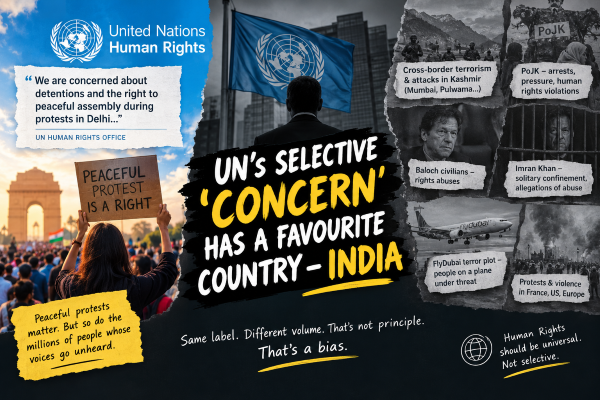
Like, for years India’s dealt with cross-border terrorism, especially the Pakistan-sponsored kind. Attacks in Kashmir, Mumbai, Pulwama — regular people caught in the middle. You don’t really see strong, consistent campaigns from that same office about the victims. Then suddenly there’s a statement about demonstrators and civil society in Delhi. Protecting peaceful protest is valid, no argument there. But the selective volume is what feels weird.
Same with PoJK. People there have faced arrests and pressure under Pakistani military control for a long time. Baloch civilians have their own long list of reported rights issues with the army. Former PM Imran Khan sitting in solitary with serious allegations around his treatment. Even the FlyDubai terror plot angle — actual people on a plane under threat. And the recent protest violence in France, the US, Europe. On a lot of those, the official account is just… quieter. Sometimes completely silent.
I’m not saying India gets a free pass or that every protest should be ignored. Governments everywhere mess up, and calling out excesses is healthy. Peaceful assembly matters. The issue is consistency. When an organisation that carries the “human rights” label only finds its strongest voice in certain places and goes low-key on others, it starts looking less like principle and more like selective attention.
As an 18-year-old who’s spent too many nights debugging systems, this feels a bit like a biased dataset problem. The feed seems trained to notice some patterns more than others. That doesn’t automatically make every statement wrong — it just makes the overall posture harder to take at face value. Once you notice the gaps, it’s tough to unsee them.
GenZ grew up online. We see the timelines side by side. We notice when the same account is quick to type “we are concerned” in one direction and slower (or silent) in another. Pointing that out isn’t hate or trauma-dumping. It’s just pattern recognition. And patterns matter if the brand is supposed to be universal.
The UN Human Rights post about Delhi asked authorities to respect peaceful assembly. Fair ask on its own. But when the same body stays mostly muted on long-running cases of civilians under pressure elsewhere, the moral weight of the statement gets lighter. Consistency would actually make those statements hit harder. Without it, they start sounding more like selective commentary than solid principle.
Anyway, that’s my slightly calmer take after sleeping on it. The double standard is still there. It’s just less rage-y when you say it out loud. Still feels like something worth noticing though.