“I'm Fine.” Are We Really?
World Mental Health Day 2026 | Lived Experiences Heard: Real Voices, Real Change


“I'm Fine.” Are We Really?
World Mental Health Day 2026 | Lived Experiences Heard: Real Voices, Real Change
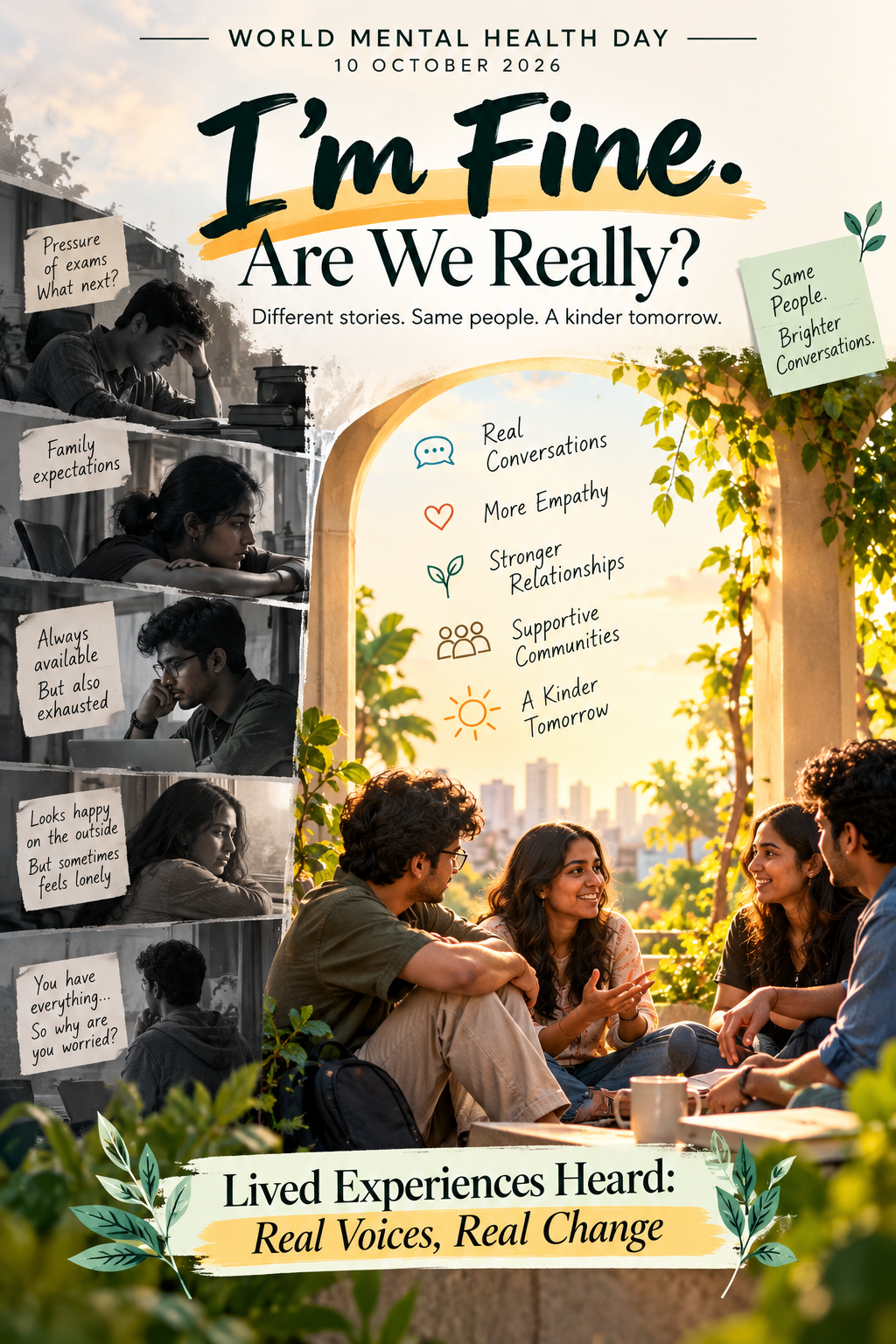
“Hey, how are you?” “I'm fine. You?” “Same. Just busy.” And that's it conversation over. We move on to the next message, the next meeting, the next reel. But what if the person saying “I'm fine” is worried about their career? What if they're struggling with family expectations, a relationship, or a future that doesn't look as certain as everyone expects? Of course, not everyone who says they're fine is hiding something. Sometimes, we're genuinely fine. But sometimes, “I'm fine” is simply the easiest answer to a question we don't know how to answer honestly. And that makes me wonder: Have we become better at asking people how they are, or have we simply become comfortable with not knowing?
We Have an Answer for Everything
Think about a student preparing for a competitive examination. They've attempted it before, their friends have started earning, and relatives keep asking when the results will come. One day, they admit, “Yaar, bahut stress ho raha hai.” The response? “Arre, itna tension mat le. Padhai pe focus kar.”
The advice might come from a good place. But the student probably already knows they need to study. What they may be struggling with is the uncertainty of how long to continue, what happens if they don't clear it, and how to explain those fears at home. Sometimes, the problem isn't that nobody is offering advice. It's that everyone is offering advice before understanding the problem.
The same thing happens at work. An employee who is always available, completes every task, and never says no is praised for being dependable. When they finally admit they're exhausted, someone responds, “But you handle everything so well!”
We celebrate their ability to manage everything without asking whether they should have to manage everything alone.
Kabhi-kabhi hum kisi ki strength ko itna admire karte hain ki bhool jaate hain unhe bhi support ki zaroorat ho sakti hai.
The Person Behind the Smile
Think about the friend who makes everyone laugh. They organise plans, crack jokes, listen to everyone's problems, and somehow keep the group together. Because they're always cheerful, we assume they're doing fine. But a person's behaviour in a group cannot tell us everything about what they feel. They might be perfectly happy, dealing with something privately, or simply not ready to talk. We cannot know without giving them the space to tell us.
Then there is the person who tries to explain that they're struggling, only to hear, “Tumhare paas toh sab kuch hai. Kis baat ki tension hai?” Maybe they have a loving family, a stable home, and access to education. Those things can matter enormously. But gratitude and emotional difficulty can exist together. Having certain privileges doesn't mean someone is never allowed to have a difficult day.
We are often quick to explain why someone shouldn't feel this way, and much slower to understand why they do.
Are We Listening, or Just Waiting to Reply?
There is a difference between hearing someone and listening to them. When a friend shares a problem, we immediately search for a solution. We compare their situation with ours, offer advice, or remind them that somebody else has it worse. We want to help. But in our hurry to make things better, we sometimes make people feel that their feelings need to be defended before they can be discussed. What if we paused instead? Instead of saying, “Don't overthink,” we asked, “Do you want to tell me what's been on your mind?” Instead of saying, “Everyone has problems,” we said, “I may not fully understand, but I'm listening.”
And instead of immediately promising that everything would be fine, we asked, “What would help you right now?” Har baar solution dena zaroori nahi hota. Kabhi-kabhi kisi ko bas apni baat poori karne dena bhi bahut hota hai.
Listening doesn't require perfect words or professional expertise. It requires patience, respect, and a willingness to understand an experience different from our own. It also means respecting someone's boundaries. We shouldn't force people to open up, assume that every quiet person is struggling, or believe that friendship alone can solve every difficulty. When someone needs more support, helping them access professional care can be an important step.
What Does It Mean to Be Heard?
The World Mental Health Day 2026 theme, “Lived Experiences Heard: Real Voices, Real Change,” brings us back to something we can practise in ordinary life. A person's experience doesn't become less real because we haven't experienced it ourselves. The student, the employee, the cheerful friend, the family member we see their roles, their achievements, their responsibilities. But we don't automatically know what those experiences mean to them. Real change doesn't always begin with a campaign or a seminar. Sometimes, it begins at the dinner table, in a college corridor, during a phone call, or in a conversation where someone is finally allowed to finish speaking. We may not always know what to say. That's okay. We can ask questions, listen without judgement, and learn to respond differently.
The Next Time Someone Says “I'm Fine”
Maybe the next time someone tells you they're struggling, resist the urge to immediately correct their thinking, compare their problems, or tell them to stay positive. You don't need to turn every conversation into a serious discussion. You simply need to be willing to listen if it becomes one. Because the real test isn't whether we encourage people to speak up. It's what we do when they finally do. We keep asking people to be honest about how they feel. But are we ready to hear an answer that isn't convenient, cheerful, or easy to fix? Maybe mental health conversations don't begin when someone finally finds the courage to speak.
Maybe they begin when the rest of us learn how to listen.